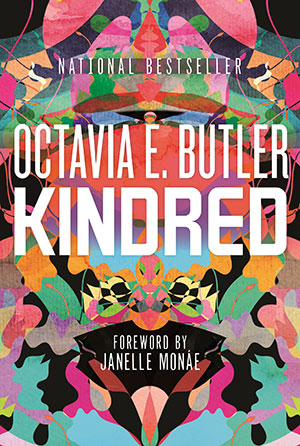
When 26-year-old Dana vanishes from her home and is transported to the antebellum South, she soon realizes why she was summoned to the past: to protect Rufus, the son of the slave-owning plantation family, and ensure his safety so that he may live into young adulthood. It isn’t until after Dana endures multiple trips that she learns the truth of their relationship and how her very existence in her own time is dependent on helping Rufus survive in his. These increasingly long and perilous trips not only force Dana as a modern-day Black woman to experience and accept the savagery of her own slavery in the 1800s but also pull her further away from her autonomy and her return to the present.
I’ve had Kindred on my radar to read for a while, and when I wrote up my original list of classics for 2026, it was at the top of the list. I’m so glad I finally read it, and finally read Octavia Butler’s work, which I will definitely be doing more of in the time to come. I should have read this long before now. Kindred is a powerful story and out of all the books I’ve read in 2026 (25 to date per my Story Graph tracking) it is the book that stuck with me the longest after reading. I found myself musing about Dana and her husband Kevin’s relationship post time traveling trips while making dinner, thinking about her paradoxical relationship with her ancestor Rufus Weylin while doing laundry, thinking about what horrors humans will quickly acclimate to, and telling my husband all about the compelling narrative I’d been sucked into.
Beyond being a powerful first-person account of the horrors of slavery, Kindred is simply a well-told and well thought out story. I highlighted an Octavia Butler quote in my reader’s guide discussion of avoiding using fiction as a soapbox: “Fiction writers can’t be too pedagogical or too polemical.” With Kindred, she nailed the assignment of a fiction writer to first tell an engaging story. And by doing that, she allows people to possibly then be educated or to feel deeply about some of our more shameful national history.
For such a fantastical premise, Kindred is not complicated at all. It’s a straight forward story that doesn’t get bogged down in the whys of the whole time travel thing- it’s never explained what is happening. It just happens, the way that other traumatic life events do. The characters, their decisions in reaction to these strange events, and their emotional journeys are what propels the story forward.
This is one classic I would recommend to everyone to read. It’s a tough, rather depressing read with the subject matter and not one to read if you’re not in the healthiest mental space or would struggle to read content with sexual assault. But if you can go on the journey with Dana through Kindred, you’ll be rewarded by a compelling, thought-provoking story filled with deep insights of human nature through time and the twisted webs of the past that come together to bring us to this very moment in time.
Quotes from Kindred by Octavia Butler:
“If I was to live, if others were to live, he must live. I didn’t dare test the paradox.”
“Repressive societies always seemed to understand the danger of “wrong” ideas.”
“What had Weylin said? That educated didn’t mean smart. He had a point. Nothing in my education or knowledge of the future had helped me to escape. Yet in a few years an illiterate runaway named Harriet Tubman would make nineteen trips into this country and lead three hundred fugitives to freedom.”
“I never realized how easily people could be trained to accept slavery.”
“That’s history. It happened whether it offends you or not. Quite a bit of it offends me, but there’s nothing I can do about it.”
“He wasn’t a monster at all. Just an ordinary man who sometimes did the monstrous things his society said were legal and proper.”
“The time, the year, was right, but the house just wasn’t familiar enough. I felt as though I were losing my place here in my own time. Rufus’s time was a sharper, stronger reality. The work was harder, the smells and tastes were stronger, the danger was greater, the pain was worse … Rufus’s time demanded things of me that had never been demanded before, and it could easily kill me if I did not meet its demands. That was a stark, powerful reality that the gentle conveniences and luxuries of this house, of now, could not touch.”
“She had done the safe thing—had accepted a life of slavery because she was afraid. She was the kind of woman who might have been called “mammy” in some other household. She was the kind of woman who would be held in contempt during the militant nineteen sixties. The house–***-, the handkerchief-head, the female Uncle Tom—the frightened powerless woman who had already lost all she could stand to lose, and who knew as little about the freedom of the North as she knew about the hereafter.”
“This could be a great time to live in,” Kevin said once. “I keep thinking what an experience it would be to stay in it—go West and watch the building of the country, see how much of the Old West mythology is true.”
“West,” I said bitterly. “That’s where they’re doing it to the Indians instead of the blacks.”
He looked at me strangely. He had been doing that a lot lately.”
More Classic Club Reads