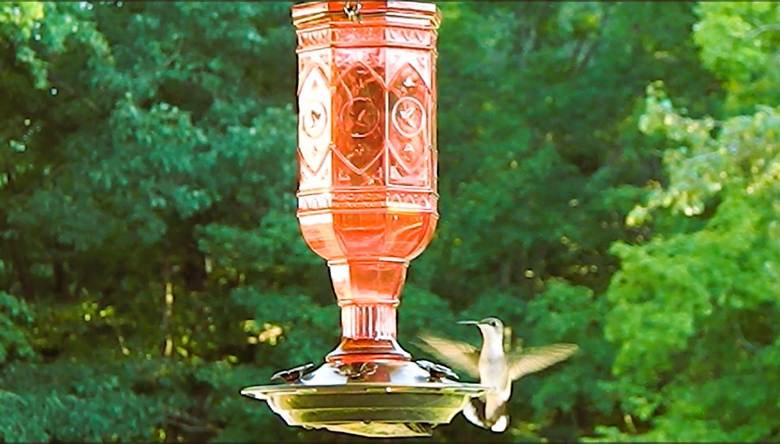
It’s closing in on mid-October here in middle Tennessee, and the vibrant hummingbird activity around our garden is winding down. I did see a couple of hummingbirds hit the feeder yesterday morning, but they aren’t my regular birds and I suspect they were just passing through on their way south since the all-day activity of birds regularly coming by the feeders every 15 minutes or so has ended.
To say we’ve enjoyed watching our hummingbirds in the garden this summer would be an understatement. My parents gave me a second feeder earlier this year and we planted more salvia which the hummingbirds seem to really like so we’ve really stepped up in our birdwatching game. I tried to practice getting some videos and pictures, but like my attempts at lunar photography, the results left a lot to be desired. But much like that lunar photography experience, it’s still fun to just sit out on the porch watching them while trying to get some good pictures. Those mid-air battles can be quite dramatic.
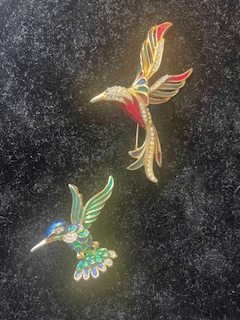
Hummingbirds are one of those species in the animal kingdom that seem to especially fascinate us humans. Sir David Attenborough said of them in his documentary Jewelled Messengers (2012), that “they are the celebrities, the stars of the bird world.” There are over 11,000 species of birds, but hummingbirds hold an elite status in the collective human imagination inspiring art, poetry, jewelry, and tattoos amongst other things. I myself inherited two hummingbird brooches as a part of my grandmother’s brooch collection. I wear them pretty regularly on Sundays.
And is it any wonder why they continue to fascinate us? Flying backwards, upside down, wing beats up to 80 times per second. Dramatic lifestyles of near constant eating to support their massive energy use during the day, then surviving the night in a state of torpor. Anna’s hummingbirds have been clocked at 60 mph during courtship dives, experiencing up to 10gs of force on their little bodies. I’m no expert on these things, but recently watching Top Gun: Maverick, they made a pretty big deal of it when the fighter pilots were expected to hit 9gs during a maneuver.
And then there is the incredible migration that many hummingbirds take on twice a year- the return part of the journey which is happening right now. There is still some mystery as to how the small birds survive a 500-mile non-stop flight across the Gulf of Mexico. They double their body weight over the course of just a few days in preparation for the journey, then set out for an 18–24-hour marathon across the water.
This video from a drilling rig in the Gulf from 2015 might take away a bit of the mystery of how at least some of these birds survive their trip.
At age 53, Walt Whitman suffered a stroke, and he was left with partial paralysis on his left side. He spent the next few years working to regain his mobility, and true to form, he used nature as therapy, taking walks along Timber Creek in New Jersey. His work Specimen Days (1882) is a collection of essays and diary entries from this period of recovery. Specimen Days covers vast topics from Whitman recalling his time as a nurse in Washington, D.C. during the Civil War to writing about the loss of his mother to reflections on his stroke recovery at Timber Creek.
In one entry, named “Three of Us”, Whitman writes, “Among the objects of beauty and interest now beginning to appear quite plentifully in this secluded spot, I notice the hummingbird, the dragonfly with its wings of slate color’d gauze, and many varieties of beautiful and plain butterflies, idly flapping among the plants and wild posies……. I see lots of these and much else in every direction, as I saunter or sit. For the last half hour a bird has persistently kept up a simple, sweet, melodious song, from the bushes. (I have a positive conviction that some of these birds sing, and others fly and flirt about here, for my especial benefit.)”
Across time and locations, scientists, poets, and us everyday bird watchers alike have appreciated these little birds and often feel as though that sentiment expressed by Walt Whitman 144 years ago is true: “I have a positive conviction that some of these birds sing, and others fly and flirt about here, for my especial benefit.”
Here is a video of some of the hummingbird activity we saw in our garden this year!


Leave a Reply