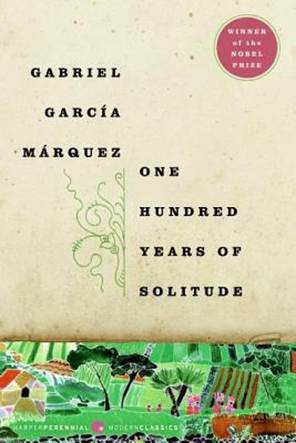
Description:
Gabriel García Márquez’s One Hundred Years of Solitude, first published in 1967, is widely considered one of the most significant novels of the 20th century. This sweeping saga chronicles seven generations of the Buendía family in the fictional town of Macondo, weaving together elements of magical realism, Colombian history, and universal themes of love, war, and the cyclical nature of time. The novel sold millions of copies worldwide, won numerous awards, and helped García Márquez secure the Nobel Prize in Literature in 1982.
In 1970, when One Hundred Years of Solitude was first published in English, author William Kennedy wrote in his review in the National Observer, “One Hundred Years of Solitude is the first piece of literature since the Book of Genesis that should be required reading for the entire human race.”
That’s quite a review. Reading One Hundred Years of Solitude does feel a bit like reading some biblical passages with its omniscient point of view that follows multiple generations of the same family in the town of Macondo, smoothly going from family member to family member while juggling a huge story scope. Plagues strike Macondo that feel straight out of Exodus, a character ascends up into heaven, and the story of Macondo follows its Edenic beginning to an apocalyptic ending based on a prophesy made generations before.
The scope of the story really is impressive and the fact that Gabriel Garcia Marquez manages to keep the story of the six generations of Buendías to a little over 400 pages is quite the feat. Scenes of the mundane intertwine with the fantastic, all told from that all-seeing, all-knowing point of view. For me, that omniscient POV could feel a bit dull at times, but then suddenly switch to quite interesting, and that might kind of be the point.
I mostly listened to the audiobook (while knitting) and I think that kept me going through some of the mundane sections. I don’t usually use spark notes too much when reading, as I just want to read and enjoy a story, but sometimes it helps to have some guidance to be able to enjoy a story more. And this novel was one of those times. A Buendía family tree is priceless when lost in the sea of Jose Arcadios and Aurelianos. It helped to be able to keep track of who was who in the overlapping narratives and feel like I had a bit of a better handle on what was happening.
The most striking scenes of the novel for me were the scenes of the massacre of the banana plantation workers and resultant cover-up. When lone survivor Jose Arcadio Segundo tries to talk to people about what happened, everyone denies that any such event took place. That history erasure reminded me of the saying, “History is written by the victors.” Jose Arcadio Segundo spends the rest of his life in solitude, tutoring Aureliano, and trying to preserve the memory of what happened.
It wasn’t until I later as I was reading through Spark Notes to try and get a better grasp of everything happening in the novel, that I learned that the incident with the banana plantation workers was based on real events. Aa a child, Gabriel Garcia Marquez lived near the banana plantation in Ciénaga, Columbia owned by United Fruit Company (now Chiquita). An unknown number of workers and their families were massacred in 1928 when they went on strike and their bodies thrown into the ocean. The estimated number of people killed ranged as high as 2000. The reports following the massacre were highly varied depending on the news source. Over the next decade, United Fruit ran lots of PR campaigns including using their cargo ships, “The Great White Fleet”, as passenger cruise ships to bring tourists to Central and South America. They sold these excursions as exotic adventures in beautiful locales, while carefully hiding the corruption and working conditions of their plantations.
The Banana Massacre is a terrible bit of history that I probably wouldn’t have come across had it not been for reading this novel.
This is a great novel and it’s easy to see why it is so highly regarded. I was blown away by the balance of such a huge scope and the wonderful sense of place you come away with after spending time in Macondo. Just from the standpoint of reading for sheer enjoyment, I’m not going to be calling it my new favorite novel- there’s honestly not really any likeable characters here (but they do all feel very real and human), lots of incest, and no real redemption for any of the six generations of Buendías stuck in their cycles of isolation and single-minded obsessions. But despite not being perfectly riveted throughout the entire book, the final passages gave me literal chills. It caught me quite off guard how strongly I reacted to the final sentences and I was about ready to immediately re-read the novel.
Sources:

