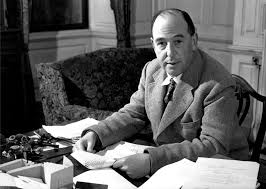
Because he was such a prolific writer of essays, we know exactly what C.S. Lewis thought about a wide variety of topics including Christmas. Turns out, he had some pretty relatable and amusing thoughts, even though fans of the Father Christmas character in The Lion, the Witch, and the Wardrobe might be surprised that the author’s views on the holiday season could be considered as rather scrooge-ish.
Exmas vs. Crissmas
In 1954, Lewis published an essay called “Xmas and Christmas: A Lost Chapter from Herodotus” in which he envisions a fictional place called Niatirb. That’s Britain backwards. You can’t accuse C.S. Lewis of being subtle. In Niatirb, there are dueling celebrations that occur on the same day.
Exmas, a gluttonous holiday of excess and obligation which leaves everyone drained.
And then there is Crissmas. A celebration of the birth of Christ that leaves its celebrants renewed.
The Whole Dreary Business
In 1957, Lewis completely dropped the allegorical pretense with his essay “What Christmas Means to Me”. In this essay, he skewers “the commercial racket” that calls itself Christmas.
“It gives on the whole much more pain than pleasure. You have only to stay over Christmas with a family who seriously try to ‘keep’ it (in its third, or commercial, aspect) in order to see that the thing is a nightmare. Long before December 25th everyone is worn out — physically worn out by weeks of daily struggle in overcrowded shops, mentally worn out by the effort to remember all the right recipients and to think out suitable gifts for them. They are in no trim for merry-making; much less (if they should want to) to take part in a religious act. They look far more as if there had been a long illness in the house.”
“Most of it is involuntary. The modern rule is that anyone can force you to give him a present by sending you a quite unprovoked present of his own. It is almost a blackmail. Who has not heard the wail of despair, and indeed of resentment, when, at the last moment, just as everyone hoped that the nuisance was over for one more year, the unwanted gift from Mrs. Busy (whom we hardly remember) flops unwelcomed through the letter-box, and back to the dreadful shops one of us has to go?”
“We are told that the whole dreary business must go on because it is good for trade. It is in fact merely one annual symptom of that lunatic condition of our country, and indeed of the world, in which everyone lives by persuading everyone else to buy things. I don’t know the way out. But can it really be my duty to buy and receive masses of junk every winter just to help the shopkeepers? If the worst comes to the worst I’d sooner give them money for nothing and write if off as a charity. For nothing? Why, better for nothing than for a nuisance.”
Families looking like there has been long illness in the home. An “unprovoked present”. The nuisance being over for one more year. The dreadful shops. The whole dreary business. C.S. Lewis really knows how to paint a picture and its not exactly a Hallmark movie.
Delinquents in the Snow
In 1957, Lewis wrote a piece called “Delinquents in the Snow”. In case the tone of this piece wasn’t obvious by the title, here are a couple of snippets:
“At my front door they are, once every year, the voices of the local choir; on the forty-five other annual occasions they are those of boys or children who have not even tried to learn to sing, or to memorize the words of the piece they are murdering. The instruments they play with real conviction are the doorbell and the knocker; and money is what they are after.”- C.S. Lewis, Delinquents in the Snow (1957)
“There! They’re at it again. “Ark, the errol hyngel sings.” They’re knocking louder. Well they come but fifty times a year. Boxing Day is only two and a half weeks ahead; then perhaps we shall have a little quiet in which to remember the birth of Christ.” – C.S. Lewis, Delinquents in the Snow (1957)
C.S. Lewis basically wrote an entire essay to say, “get off my lawn, kids.” But seriously, in the essay he goes on to speculate that some of those not-so-great carolers were the same boys who had recently stolen from his yard and been given a slap on the wrist by the court system, so this particular essay is really more about his views of the current justice system. But he still makes his point on Christmas clear. “Then perhaps we shall have a little quiet in which to remember the birth of Christ.” It may not have been the main point of this particular essay, but he still obviously had more to say about the birth of Christ taking a back seat to secular traditions.
The Grand Miracle
Lewis wrote quite a lot about the incarnation and used different metaphors to describe it and its meaning to humanity. Through his intellectual wrestling with faith, he’d obviously given the birth of Christ quite a lot of thought and he referred to it as “the grand miracle” in which all other miracles both before and to come hinged.
“In the Christian story God descends to reascend. He comes down; down from the heights of absolute being into time and space, down into humanity; down further still, if embryologists are right, to recapitulate in the womb ancient and pre-human phases of life; down to the very roots and seabed of the Nature He has created. But He goes down to come up again and bring the whole ruined world up with Him.”- C.S. Lewis, Miracles (1947)
“…the Christian story is precisely the story of one grand miracle, the Christian assertion being that what is beyond all space and time, what is uncreated, eternal, came into nature, into human nature, descended into His own universe, and rose again, bringing nature up with Him. It is precisely one great miracle. If you take that away there is nothing specifically Christian left. There may be many admirable human things which Christianity shares with all other systems in the world, but there would be nothing specifically Christian.”- C.S. Lewis
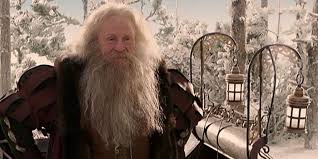
I don’t think it would be fair to dismiss C.S. Lewis as a grinch. For all his ranting against commercialism, he also said, “I much approve of merry making” in his “What Christmas Means to Me” essay. He was known to give presents to children for Christmas. And he added the Father Christmas character to the world of Narnia to end “the long winter” and be an early sign of Aslan being on the move. When Father Christmas came to Narnia, he brought gifts to the children that were invaluable in their battles to come. It wasn’t gifts and the joy they can bring that C.S. Lewis was against. It was humans being “blackmailed” as he phrased it by our desire to do good for others into spending more and more on excess. And the fact that the excess trappings can keep us so busy that the true meaning for the holiday is overshadowed by a million twinkle lights.
If Christ’s coming to earth in human form is the central miracle around which all the others before and to come hinges, then why do we allow it to be overshadowed by everything else this time of year? Maybe we should take a page out of C.S. Lewis’ book and be a bit more grinchy when it comes to our excessive spending, gift giving, card sending, over booked, stressed ways. “Then perhaps we shall have a little quiet in which to remember the birth of Christ.”
 Rachel F. Jean
Leave a comment