
When I was pregnant with our daughter, my husband and I found ourselves in a Buy Buy Baby after a doctor’s appointment. We walked up and down the aisles, taking notes and feeling slightly overwhelmed by all the gear that apparently came along with a new baby. My husband asked if all this was necessary, and I assured him that most of it probably wasn’t.
“So, it’s like a fishing store?” he asked.
“What do you mean?” I replied.
“Well, the old joke goes that most everything in a fishing store is there to catch you, not fish,” he said.
Some real fishing wisdom there.
Last month, I read Grandma Gatewood’s Walk by Ben Montgomery. I have been interested in Emma Gatewood’s story for a few years now and I am glad I finally got around to reading more about this fascinating lady.
In 1955, Emma Gatewood became the first woman to solo thru-hike the Appalachian Trail at 67 years old. Among the many inspiring elements of her story, one of the most striking details is how little she carried on her journey of 2,050 miles from Georgia to Maine. Indeed, in the intervening years, Emma Gatewood has become known as a pioneer of ultralight backpacking due to her ruthless culling of anything not absolutely necessary on the trail. And among the things she deemed not necessary: a tent, a sleeping bag, and a map. She slept on picnic tables, piles of leaves, shelters along the trail, and sometimes in the homes of strangers she met along the way. On cold nights, in lieu of a sleeping bag, she warmed rocks on a fire and slept on top of them for warmth. The hand-sewn sack she carried on her shoulder weighed less than 20 pounds.
“I slept wherever I could pile down. Course, sometimes they weren’t the most desirable places in the world, but I always managed. A pile of leaves makes a fine bed, and if you’re tired enough, mountain tops, abandoned sheds, porches, and overturned boats can be tolerated. I even had a sleeping companion. A porcupine tried to curl up next to me one night while I slept on a cabin floor. I decided there wasn’t room for both of us.”
Along her journey, she met many people. Two of the people she met were young sailors in the navy who met “Grandma” at a shelter in a particularly rugged and isolated part of the trail. They were shocked to meet a lone “elderly woman” under such circumstances, and even more surprised when they learned that she had hiked all the way from Georgia carrying only a shoulder sack with less than 20 pounds of gear. For ten days hiking, they had each packed 55 pound back packs. Emma proved her toughness to them though after they met up with her again at a water crossing that was swollen due to recent downpours from a hurricane that devasted the Northeast region. The three of them crossed tied together with some parachute cord, and upon safely getting to the other side, Emma said, “Well, you got Grandma across.” One of the men recalled the incident years later and said that, “She was one tough old bird.”
Emma told a reporter in 1955, “Most people today are pantywaist.” I’m not sure we’d want to hear her commentary on our collective state in 2024. Much like my husband’s joke about all the gear in fishing stores being there to catch us as consumers instead of fish, I can imagine Emma just walking through a REI store rolling her eyes at what people are being sold as “necessities” to a successful outdoor excursion. This was a woman who hiked with keds on her feet until they were literally falling apart through cold and wet terrains, used a cheap shower curtain as rain protection, fashioned a dress for herself with a blanket and safety pins when her hiking clothes got wet, and foraged berries and edible plants to sustain herself when her food stores got low.
Emma Gatewood is a good reminder on this Black Friday that we don’t need as much “stuff” as we think we do in most situations.
This is really meant to be more of a general life reminder than a commentary on what’s necessary for a successful thru-hike. I just enjoy doing some day hiking in my local state parks, so I’m not the one to say what’s necessary or not. There’s plenty of hiking blogs out there to discuss ultralight packing. I think most people who aren’t Emma Gatewood would genuinely need more provisions in order to stay safe on the trail. People die from being under prepared in the back country, and mimicking Emma would not be advisable for most of us who are less knowledgeable than she was about edible plants and who do not possess her resourcefulness. And it wasn’t like she didn’t plan or think her trip through. Her family found out later that prior to her trip she had been going on overnight camping trips in the woods closer to home to learn what supplies were absolutely necessary and what foods were lightweight to carry while still being good sources of energy for her hike. But her example highlights the fact that we can usually live with a lot less than we believe we need.
Grandma Gatewood’s Walk by Ben Montgomery
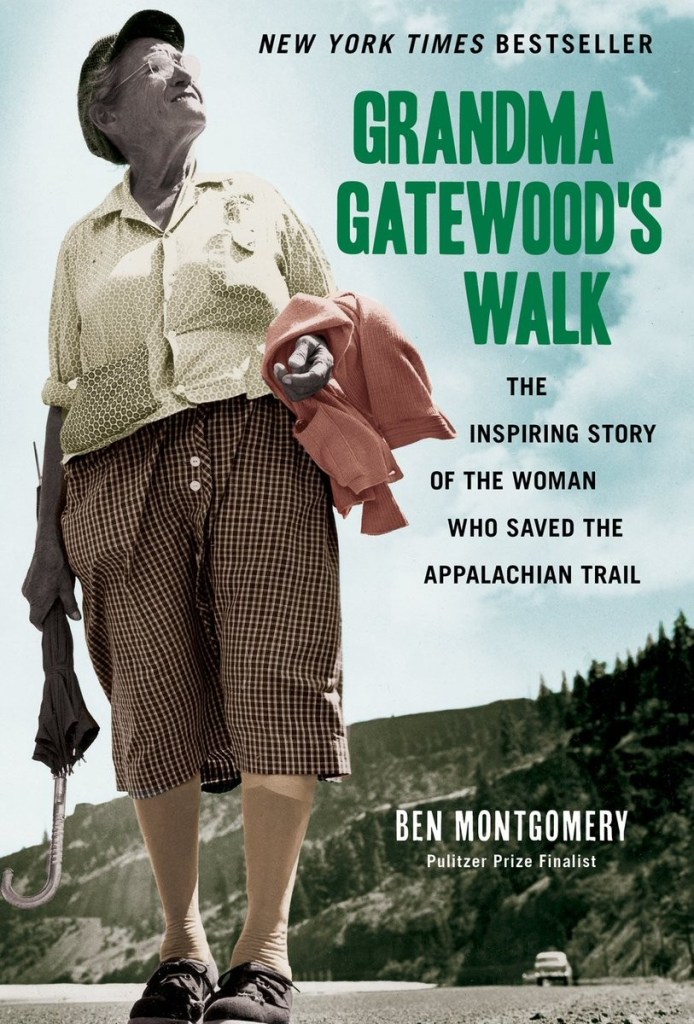
I really enjoyed Grandma Gatewood’s Walk. It blended Emma’s earlier history with a narrative of her first journey along the Appalachian Trail using her trail journals, diaries, and personal correspondence. It also intermingled Emma’s story with the history of the Appalachian trail itself along with the greater cultural picture of the 1950’s to give even better context to Emma’s story. She was walking at a time in history when humans were walking less and less because of automobiles, and she had a lot of thoughts on that.
Despite only having a formal education through the 8th grade, Emma read everything she could get her hands on in between her farms chores and raising her 11 children. She liked to write poetry and her habit of taking long walks began during her abusive marriage. The details that her children recall of the abuse that Emma suffered are chilling. Her husband actually killed a man after their 9th child was born in a fit of temper, but he didn’t serve any time after being convicted of manslaughter because he “had nine children and a farm to tend to”. After 35 years of beatings which broke multiple teeth and ribs, Emma was granted a divorce. She told reporters who came to interview her along her journey of the Appalachian Trail that she was widowed despite the fact that the man she had been married to was alive and well in Ohio.
Even though Emma told a reporter that she found an “aloneness more complete than ever” while on the trail, she was also someone who clearly enjoyed meeting others and she had no issues introducing herself to strangers, making new friends, and staying with kind strangers she met along the way. She also really seemed to enjoy her times talking with boy and girl scouts that she met and telling them about her trip. These meetings lived in the minds of some of those young people for years to come based on interviews with them as adults.
Emma did break one of the cardinal rules of outdoor exploration- she didn’t tell anyone where she was going. She told her 11 grown children that she was “going for a walk”. Not exactly a lie. She had attempted a southbound trek down the Appalachian Trail in 1954, and she didn’t get far before she had to be rescued by rangers in Maine who told her to “Go home, Grandma.” She never told her family about that failed trip and maybe she didn’t want them to know if another trip turned out to be unsuccessful.
Emma had first read about the Appalachian Trail in an old National Geographic magazine some years before she set out, and the pictures of the beautiful vistas stayed with her until she could make the trek for herself. She was repeatedly asked by reporters why she was taking on such a long-distance hike, and she answered with various versions of “because I want to.” When she reached the Northern terminus she sang America the Beautiful, and declared, “I said I’ll do it, and I’ve done it.”
After her first thru-hike of the Appalachian Trail, she became the first person to complete the trail for a second and third time, her third hike being completed in sections. She became something of a hiking celebrity and took on other challenges such as hiking the 2,000 mile Oregon trail at age 71.
Emma Gatewood’s legacy continues to inspire countless hikers today. Ben Montgomery talked to several people at the northern terminus of the AT and describes in his book how everyone knew something about the legend of Emma Gatewood. Maybe today, on this Black Friday, she can inspire us to not only take more walks, but to walk with a little less “stuff” along the way.
 Rachel F. Jean
Leave a comment